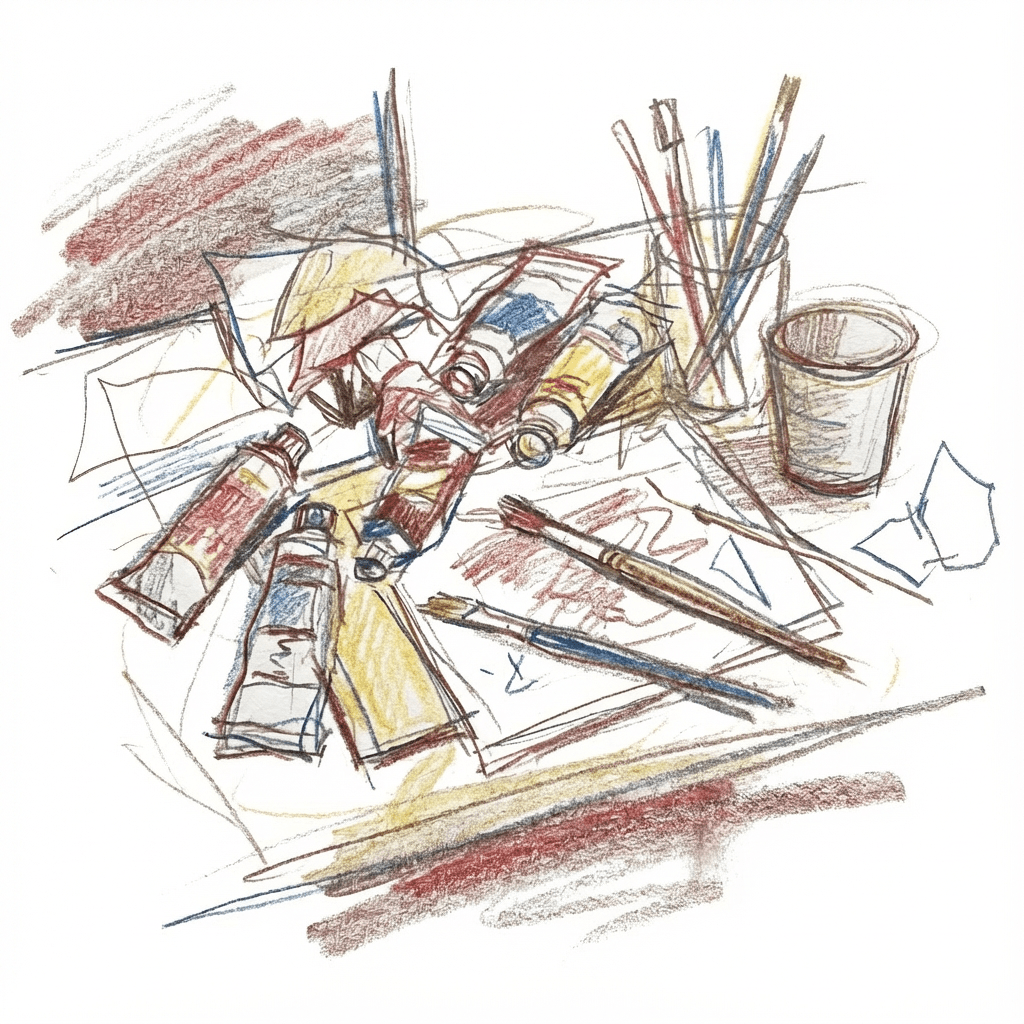
Art is something that results from making a lot of choices. Any process which leads you to make a lot of choices will inevitably result in something distinctive.
If what AARON is making is not art, what is it exactly, and in what ways, other than its origin, does it differ from the real thing?
What makes AI output artistic
We live in an era where ideas become images in the blink of an eye. The patient whispers of bristles upon canvas have given way to typed prompts. The deliberate dance of graphite across paper now competes with algorithms that generate in seconds what might take weeks by hand.
This condensation of the creative process provokes a predictable accusation: moving from paper to prompt means transitioning from art to 'not art'.
If the process of using AI for creation was limited to a simple prompt alone, I would agree. But this reductionist view does not do justice to the way AI artists actually work. The process of creation is one of thousands upon thousands of unique, personal choices. These are macro-decisions influenced by our life experiences but also micro-decisions shaped by the act of creating itself. The process is not simply a means to the end. It actively shapes what the end looks like in the mind of the creator.
For a classical painter, the artefacts punctuating the creative process could be the unforeseen melting of different colours as she moves through each brushstroke. Or the unexpected shadow that transforms light into revelation. These accidents become integral to the work.
Ted Chiang's influential essay, "Why A.I. Isn't Going to Make Art," captures the sceptic's position. Chiang argues that to create a novel or a painting, an artist must make thousands upon thousands of unique, personal choices. Each word, each brushstroke, carries the weight of human experience. A machine cannot replicate this.
For the AI artist, the situation is different but not lesser. The infinite configuration of prompts and parameters, edits and outcomes, and the intermediate outputs they produce all shape the direction of work. The final output becomes infused with artistic value from the spectrum of choices the artist makes and discovers. She is taming a sentient paintbrush whose intelligence she does not fully understand.
The pioneers who asked these questions first
The debate about AI and creativity is not new. Harold Cohen began asking these questions in the 1970s.
Cohen was a successful British painter who turned to programming. He created AARON, a software system that drew and painted autonomously. AARON was not a tool that Cohen used to make art. AARON made art, and Cohen was its creator.
The Whitney Museum exhibited AARON in 2024, with live drawing machines recreating Cohen's work. Visitors watched plotters draw images from different periods of the software. The machines worked autonomously, making marks on paper without human intervention. Yet each mark emerged from decades of Cohen's decisions about what AARON should know and how it should think.
Cohen once joked that he wanted to be "the first artist in history to have a posthumous exhibition of new work." He nearly achieved it. AARON can still generate new images today, years after Cohen's death in 2016.
The auction that changed everything
In October 2018, Christie's sold a portrait for $432,000. The subject was a blurred figure called Edmond de Belamy. The artist was an algorithm.
The Paris collective Obvious created the portrait using a Generative Adversarial Network. They fed the system 15,000 portraits painted between the 14th and 20th centuries. The GAN learned what portraits look like and generated its own.
The sale sparked fierce debate. Was this art? The collective had typed no prompts, made no brushstrokes. They had trained a model and selected an output. Was that enough?
Critics pointed out that Obvious used code written by Robbie Barrat, a 19-year-old AI artist who received none of the auction proceeds. The controversy highlighted questions about authorship that remain unresolved. When an artist uses another artist's tool, who deserves credit for the result?
The reframing we need
The assumption behind many objections is that art must be defined by the quantity of choices made during its creation. A painting is valuable only if every decision is manually executed. This perspective overlooks something important.
When we look at a traditional painting, we are not merely admiring its final form. We are witnessing the culmination of countless decisions. The layering of colours. The nuanced application of brushstrokes. The interplay of shadow and light. It is the accumulation of these choices that gives the work its depth.
Generative art operates on the same principle. Instead of "artist creates art," the more apt expression in the world of AI is:
"Artist crafts system; system creates art."
The algorithm is not a crutch but an extension of the artist's creative repertoire. The process itself, the way the system learns and iterates and surprises us, is a vital part of the artwork. Even when an AI produces outputs based on a concise prompt, the heart of the art lies in the creator's skill in designing, refining, and engaging with that system.
Artists who prove the point
Refik Anadol has built a career on this principle. The Turkish-American artist creates what he calls "data sculptures." He feeds neural networks with millions of images and lets them dream. The results are massive, flowing installations that transform buildings into living canvases.
His work at the Museum of Modern Art, titled "Unsupervised," trained an AI on MoMA's entire collection. The result was an infinite, ever-changing artwork that visitors watched evolve in real time. The AI had learned from Picasso and Pollock, Warhol and de Kooning. But what it created was entirely its own.
Bennett Miller took a different approach. The Oscar-nominated director of Moneyball and Capote spent three years working with an early version of DALL-E. He generated over 100,000 images, selecting fewer than 50 for his exhibition at Gagosian gallery.
Miller's process was not about automation. It was about curation at scale. He explored what the AI could do, pushed against its limits, and carefully selected the outputs that captured something true. The sepia-toned portraits he exhibited look like lost photographs from another century. They never existed until Miller coaxed them from the machine.
The question we should be asking
The debate is not whether machines can make art in the traditional sense. The question is how our definition of art must evolve.
Early generative art demonstrated that beauty could arise from systems operating on principles of chance and order. The artistic experiments of the 1960s and 1970s were radical in their insistence that the process mattered as much as the product. Over the decades, generative methods have evolved from algorithmic drawing to interactive installations. The dialogue between human input and machine output has only deepened.
Roald Dahl explored this territory in his 1953 short story, "The Great Automatic Grammatizator." An engineer invents a machine that writes stories by adhering to rigid grammatical rules. Dahl prompts us to ask: Is the automation of creative choices inherently unworthy of artistic merit? If the machine is allowed to work autonomously, is it not still a reflection of a deeply human design?
In a world where the process of creation is as important as the outcome, dismissing AI as incapable of true artistic output overlooks a rich history of creative experimentation. The generative art movement has taught us that the journey, the intricate dance between human intention and machine autonomy, is where art truly lives.
This is not the end of human creativity. It is an expansion of it.