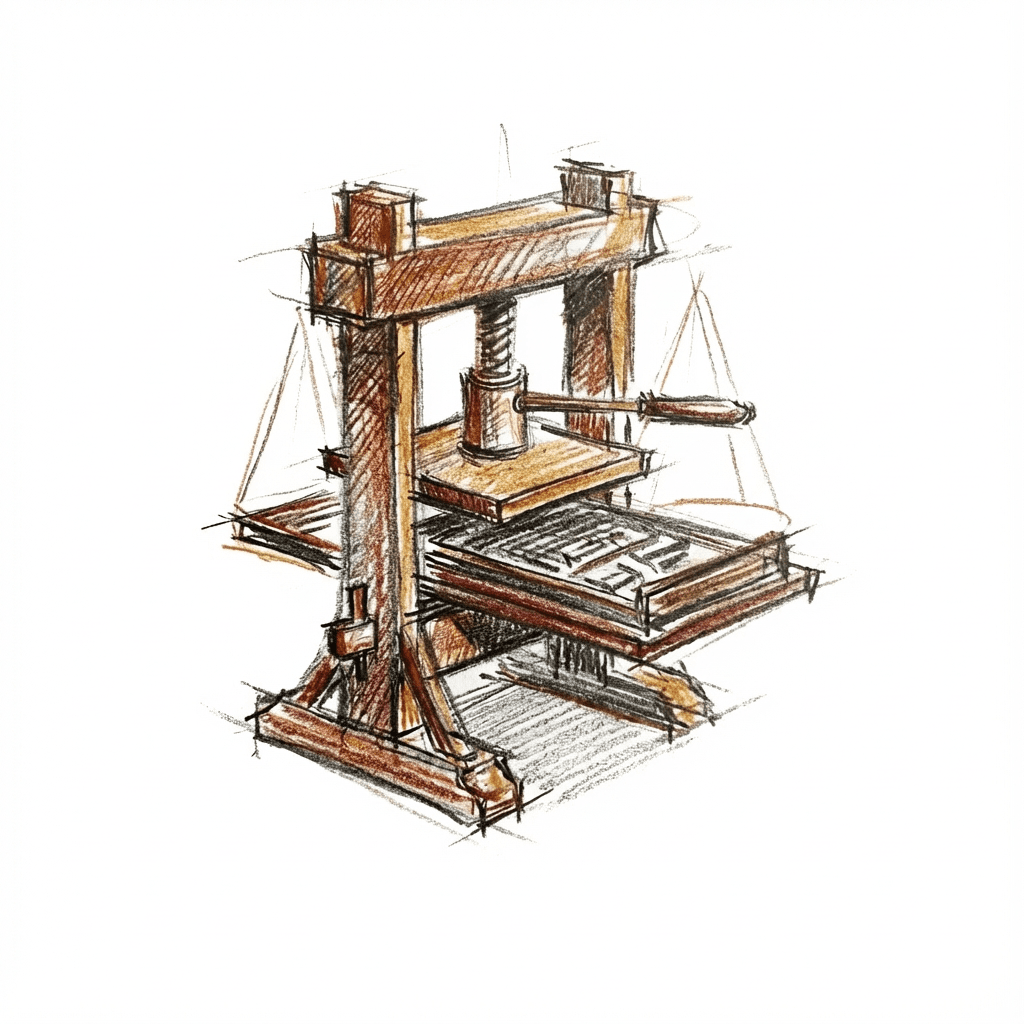
We are only a quarter century past the introduction of the commercial web browser, which puts us at about 1480 in Gutenberg years.
It is a press, certainly, but a press from which shall flow in inexhaustible streams the most abundant and most marvellous liquor that has ever flowed to relieve the thirst of men.
The Gutenberg parallel
In the mid-15th century, Johannes Gutenberg developed movable type in Mainz, Germany. The printing press would go on to democratise knowledge, catalyse the Reformation, fuel the Renaissance, and spark the Scientific Revolution. It was one of the most consequential inventions in human history.
We stand at a similar moment today.
The period between 1450 and 1500 is known as the incunabula era. The word comes from the Latin for "swaddling clothes" or "cradle." It describes a technology still in its infancy. Books printed during this time looked like manuscripts. Printers had not yet invented title pages, page numbers, or standardised typography. They were imitating what came before because they did not yet understand what they had created.
This is where we are with generative AI.
We do not yet know what we have built
After Gutenberg's first press, it took half a century for the book as we know it to evolve. Titles, title pages, and page numbers emerged slowly. It took another century, until around 1600, before the medium truly flourished. Shakespeare, Cervantes, and the Scientific Revolution all came more than 150 years after the first printed Bible.
The change we experience today, which feels rapid, is likely only the beginning. We are perhaps 25 years into the digital revolution if we count from the commercial web browser. In Gutenberg years, that places us around 1480. The incunabula period had barely begun.
Consider what we are doing with generative AI today. We use it to write emails faster. We generate images that mimic existing styles. We automate tasks that humans used to do. These are useful applications, but they are fundamentally imitative. We are using a revolutionary tool to do slightly better versions of what we already did.
The printing press was first used to print Bibles that looked like handwritten manuscripts. It took generations for people to discover that the real power of print lay not in copying the old world but in creating a new one.
Open source and rapid proliferation
Gutenberg produced what we would today call open-source technology. His design could be replicated and improved by others. Within fifty years of his first press, every major European city had printing establishments. More books were printed in that half century than scribes had produced in the previous thousand years.
Generative AI follows the same pattern. While headline companies like OpenAI operate closed models, the technology is proliferating in open source. By some estimates, over 8,000 open-source generative AI models are available on GitHub. The barriers to entry fall every month.
This proliferation is both the promise and the peril. The printing press enabled the Scientific Revolution. It also enabled The Hammer of Witches, a manual for identifying and persecuting supposed witches that led to widespread hysteria and death.
The trust problem
The printing press was not trusted when it arrived. The provenance of printed material was unclear. Anyone with access to a press could publish anything. Authorities viewed this with alarm.
The same concerns echo today. Who created this AI-generated content? What data trained this model? Can we trust what we are reading or seeing? These questions have no easy answers.
Regulation eventually emerged around printing. Licensing, censorship, copyright, and libel laws developed over centuries. They did not prevent misuse, but they created frameworks for accountability. We are in the early stages of developing similar frameworks for AI.
What comes after the incunabula
The Gutenberg Parenthesis is a theory that holds the era of print was a grand exception in human history. Before print, knowledge was oral, fluid, and communal. Print made it fixed, authored, and proprietary. Now digital technology is returning us to something more fluid again.
This framing suggests that the disruptions we experience are not aberrations but returns. The anxiety around AI-generated content mirrors the anxiety around printed books displacing manuscript culture. Both represent shifts in how we create, share, and trust information.
The incunabula era ended when printers stopped imitating manuscripts and started inventing new forms. The same transition awaits us. Generative AI will become truly transformative not when it helps us do old things faster, but when it enables things we cannot yet imagine.
We are not at the end of this revolution. We are in the swaddling clothes.
The printing press took 150 years to reshape Western civilisation. We are perhaps a decade into the generative AI era. The applications that will define this technology likely do not exist yet. The creators who will master it may not have been born.
History does not repeat, but it rhymes. The incunabula era teaches us patience. It teaches us that transformative technologies take longer than we expect to reveal their true nature. And it teaches us that the early uses of a technology rarely predict its ultimate impact.
We are still learning what the press can do.